



Shopping for a two-seat sofa, you'll run into both words quickly: one shop lists a "settee," the next calls a near-identical piece a "loveseat," and a third labels both "small sofas." It's enough to make you wonder whether there's any real difference, or whether it's all marketing.
There is a difference — it's just more about history, style, and where you grew up than about a strict measurement. This guide explains where each word comes from, how a settee and a loveseat actually differ in look and feel, and how to decide which suits your room. Along the way we'll use two of our own loveseats to show how much range a single category can cover.
Settee vs loveseat, the short answer
A loveseat is an American term for a compact two-seat sofa — fully upholstered, comfort-first, and defined by its capacity: it seats two. A settee is an older, originally British term for a seat with a back and arms that holds two or more people, descended from the wooden bench called a settle. In modern Britain "settee" is often just an everyday word for any sofa, while in the United States it tends to mean a smaller, more formal, sometimes exposed-frame seat.
So the quick version: every loveseat could loosely be called a settee, but the words carry different flavours. "Loveseat" signals a soft, sofa-like two-seater built for relaxing. "Settee" signals something more tailored and traditional — often firmer, more upright, and more decorative. The overlap is large, and most of the time either word will do — which is exactly why a one-line definition rarely settles a real buying decision, and why it pays to understand what each piece is actually built to do.
What a settee is, and where the word comes from
The settee descends from the settle — a long wooden bench with a high back and arms, often with a storage box built into the seat. Settles were fixtures of medieval and early-modern English homes, usually placed beside the hearth where the tall back blocked drafts and held in the fire's warmth. They were practical, heavy, and entirely wooden.
Over the seventeenth and eighteenth centuries that bench softened. Cabinetmakers lightened the frame, added upholstery, and refined the proportions, and the "settee" emerged as a more elegant seat for two or more. Many eighteenth-century settees kept a visible wooden frame — the "double-chair-back" settee literally looked like two matching chairs joined together — which is why, even now, an exposed or partly exposed frame reads as a settee cue rather than a loveseat one.
By the Georgian era the settee had become a genuine status piece. Chippendale and his contemporaries built them as part of matched parlour suites, with exposed mahogany frames and carved detailing meant to be admired as much as used. A settee in the best room signalled taste and means. That decorative, show-wood lineage never fully faded, which is a large part of why the word still sounds more formal than "loveseat" to a modern ear.
That history is why the word still carries a formal, traditional air. In American usage especially, a settee tends to be a smaller, firmer, more upright seat, often with carved or show-wood detailing, used where it will be looked at as much as sat on: an entryway, the foot of a bed, a dressing area, or a formal sitting room. It's the two-seater you perch on, not the one you sink into. In Britain, meanwhile, the word travelled in the opposite direction and simply became a casual synonym for the family sofa.
What a loveseat is, and where the word comes from
"Loveseat" started as a description of size — a seat sized for two people sitting close together. Its ancestors are charming: in the seventeenth and eighteenth centuries a wide chair or small settee was sometimes built to accommodate a single lady and the enormous skirts of the period, and the term "courting seat" described a two-person seat for couples. The Victorians took the idea furthest with the tête-à-tête — an S-shaped "conversation seat" with two places facing in opposite directions, so a courting couple could talk face to face while staying properly, visibly separate.
Modern usage dropped the romance and kept the dimensions. Today a loveseat is simply a compact two-seat sofa: fully upholstered, soft, and built to deliver a full sofa's comfort in a smaller footprint. It's the standard American term for the small sofa, and it's the natural pick for an apartment, a snug living room, or as a companion piece set at a right angle to a larger sofa.
In twentieth-century America the loveseat found its modern role as part of the matched "living room suite" — a sofa, a loveseat, and an armchair sold and arranged together. That packaging is what cemented it as the standard small sofa of the American home rather than a Victorian curiosity, and it's why most people today picture a loveseat as simply "the little sofa that matches the big one."

Settee vs loveseat: the real differences
Set the two side by side and the contrasts are about character rather than a tape measure. Both seat roughly two people; what changes is the look, the posture, and the room each one belongs in.
One honest caveat: none of this is governed by an industry standard. There's no official width or seat count that turns a loveseat into a settee, and manufacturers use the words loosely — the same two-seater might be sold as a "loveseat," a "settee," or a "two-seat sofa" depending on the brand and the country. Treat the label as a clue about heritage and positioning rather than a specification. When it matters, read the dimensions and look at the construction, not the name on the tag.
If you want the wider map of furniture terms — couch, davenport, chesterfield, and the rest — our guide to davenport vs sofa vs couch covers how the whole vocabulary fits together.
Choose by the feeling you want in the room — tailored and upright, or soft and easy — not by which word the label happens to use.
Choosing between a settee and a loveseat
Because the two overlap so much, the decision comes down to how you want to sit and how the room is meant to feel. A few questions sort it out quickly.
Where a settee or loveseat fits in a home
A two-seater earns its keep in more rooms than the main living area, and the settee-versus-loveseat character often decides which room suits it best.
In a small living room or apartment, a loveseat frequently makes a better primary sofa than a crowded three-seater — the same space-first logic that governs a shallow-depth sofa. As a companion piece, a two-seater set across a coffee table or at a right angle to a larger sofa completes a conversation group without the bulk of a sectional.
The settee end of the family shines in rooms where a seat is looked at as much as sat on. At the foot of a bed or under a bedroom window, a tailored, upright two-seater becomes a place to sit and dress. In an entryway or foyer, its more formal, decorative character does real work in a spot that rarely gets heavy use. And in a home office or reading nook, a softer loveseat offers a second, more relaxed seat away from the desk.
Whichever you choose, the upholstery deserves a moment's thought: a two-seater concentrates wear into the same two spots day after day, so a hard-wearing, pleasant fabric pays off. If you're weighing texture against upkeep, our guide to bouclé vs velvet walks through the trade-offs.
Two loveseats that show the loveseat range
We make loveseats rather than formal settees, but the two pieces below show how much a single loveseat category can stretch — from a trim, upright seat that leans toward the settee end of things to a low, deep one built purely for sinking in. Comparing them is the clearest way to feel the difference the words are pointing at.
The Moreland is the tailored one: a tight 29.9-inch depth, a fairly upright 22.4-inch seat, and raised metal legs that keep it looking light. It sits and reads much the way an old settee would — neat, structured, and easy to place against a wall in a compact room. If your instinct leans formal, this is the loveseat that scratches that itch.

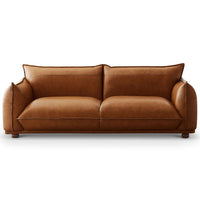
The Darfield is the opposite temperament: lower to the ground, six inches deeper, with a generous 24.4-inch seat made for lounging rather than perching. Nobody would mistake it for a settee — it's a loveseat through and through. Between the two, you can feel the whole spectrum the terminology is trying to describe.
Settee vs loveseat questions, answered
01 Is a settee the same as a loveseat?
They overlap heavily and are often used interchangeably, but they aren't identical. A loveseat is specifically a comfortable, fully upholstered two-seat sofa. A settee is an older, more formal term — often firmer, more upright, and sometimes with an exposed wood frame — that can seat two or more.
02 Is a settee bigger than a loveseat?
Not reliably. A loveseat is always a two-seater, while a settee can seat two or stretch a little longer. In practice their footprints often overlap, so size isn't a dependable way to tell them apart — style and formality are.
03 Is "settee" just the British word for sofa?
Often, yes. In everyday British English "settee" is a common word for a sofa of any size. In American English the word is used more narrowly, usually for a smaller, more formal or antique-style seat.
04 How many people fit on a loveseat?
Two adults, comfortably. Most loveseats offer roughly 42–43 inches of seat width, which is right for two people side by side. For occasional third seating, you'd want a small three-seat sofa instead.
05 Which is more comfortable for lounging?
A loveseat, generally. Its fully upholstered, deeper, softer build is made for relaxing, whereas a settee's firmer, more upright design favours posture and looks over sinking in. If lounging is the priority, choose by seat depth and cushion softness rather than by the name.